Where just transition risk shows up in a global equity portfolio: interim insights from our investor pilot
November 6, 2026
Climate & Company is developing a replicable, sector-agnostic risk screening methodology for listed-equity portfolios together with Standard Life, Swedbank Robur and ÖKOWORLD. The methodology helps identify where additional due diligence or targeted engagement is particularly relevant.
We have developed a first version of this methodology and are seeking feedback from experts and other investors to make sure our approach is sound and usable by the broader financial sector. Our risk assessment tool integrates data sets and metrics related to a just climate transition. It helps investors get a grip on the risks stemming from their portfolios. Our tool reduces complexity and highlights the portfolio companies that investors should prioritise, based on two dimensions: just transition-related risk exposure and respective risk management preparedness.
What is just transition finance, and why do social issues matter for the climate transition?
The transition to a low-carbon economy will reshape labour markets, supply chains and the communities that depend on them. Coal regions will lose jobs, steel plants will change how they produce, and demand for battery and grid minerals is opening new mines. A just transition means managing these shifts so that workers, communities and consumers are not left behind, a principle recognised in the Paris Agreement. Just transition finance asks how capital can support this, and whether the companies investors hold manage the social side of their own transition.
Why should investors care about just transition risks?
Social risks that are poorly managed rarely stay social. Once conflicts reach courts, ESG ratings or the media, they can turn into delayed projects, strikes, litigation and reputational damage, which affect cash flows and the cost of capital. The Business & Human Rights Resource Centre recorded 329 allegations of abuse linked to transition mineral mining in 2025, a 73% year-on-year increase at the mines it already tracked, and nearly 70% of the mines involved are owned by or linked to listed companies. Importantly, a transition that is seen as unfair can also erode public support for climate policy itself.
For investors, the just transition is therefore a question of risk as much as one of impact.
How investors can manage just transition risks
While there is already excellent guidance and thought leadership on just transition finance, the next challenge for investors is implementation: how can they translate these concepts into concrete portfolio analysis, stewardship priorities or transition planning? Their main lever is stewardship: knowing which companies to engage, and what to ask them.
The practical difficulty is scale: a listed-equity portfolio can hold several thousand companies, disclosures on social issues are patchy, and conventional ESG data such as emissions metrics and ESG ratings rarely addresses just transition issues directly. Our tool will help close that gap.Our screening is a due diligence tool that supports this by showing where social risk and weak preparation coincide. How investors act on the results, including in investment decisions, remains their choice.
What is at the core of our just transition finance tool for investors?
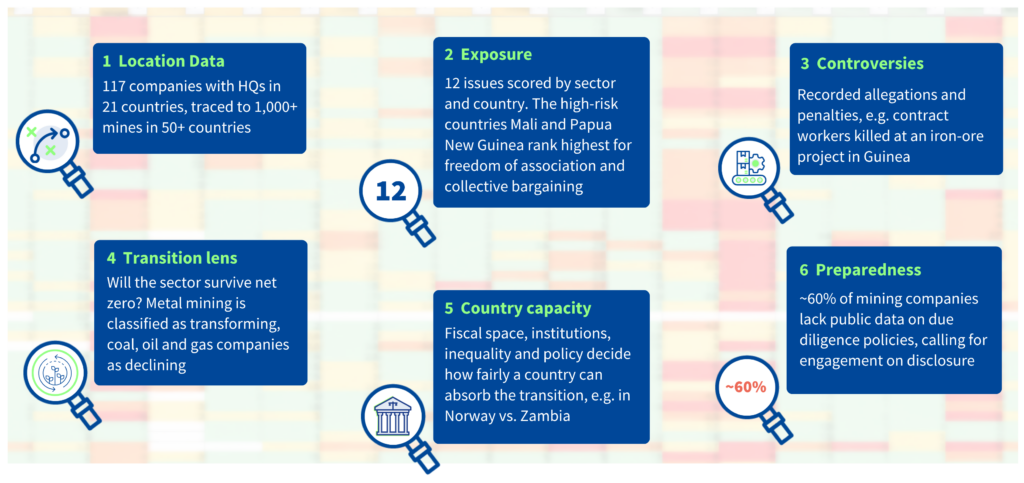
- Location data: We use data on companies’ operations, not only their headquarters. Each company and its operations are assigned to a specific sector and country. This gives a more accurate picture of where just transition risks actually arise, rather than attributing them to a single head-office location.
- Exposure: We link country- and sector-specific just transition risks. Our tool assigns a score for 12 salient just transition issues, based on which issues are likely to be more material for that specific sector and country, building largely on the work by PCAP and BSR.
- Controversies: We factor in existing evidence of recorded allegations and regulatory penalties.
- Climate transition lens: We classify each sector based on whether it will survive the climate transition (e.g. coal will disappear, metal mining will transform and renewable energy will grow).
- Country’s transition capacity: We attribute a higher risk score to companies operating in countries with lower capacity to absorb the transition (e.g. fiscal space, inequality, just transition policy framework).
- Company preparedness: We add to our assessment how well the companies are prepared to manage the just transition (e.g. whether they have policies in place for the workers and communities affected).
First results: Filtering companies based on risk exposure and risk management preparedness.
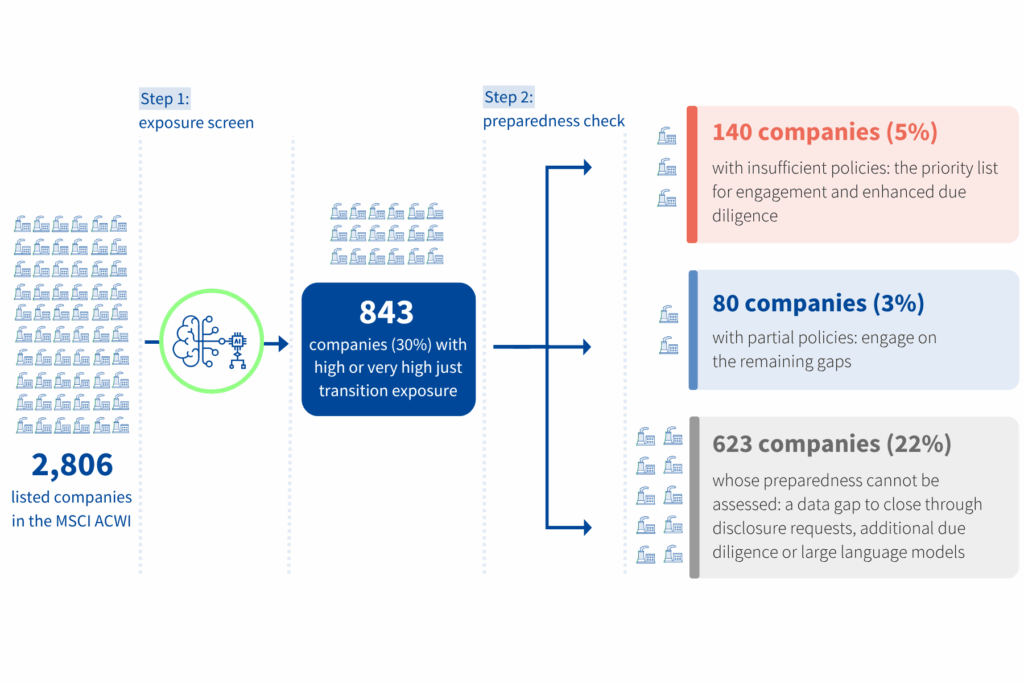
We have tested a working version on the MSCI ACWI, a global index of 2,806 listed companies. The figures come from this test run and will change as the methodology develops.
Insight 1: The headquarters is not where the impact is
We could link 837 companies to physical assets. They are headquartered in 44 countries, but their sites are spread across 164, and for 309 of them (37%) half or more of the matched assets are outside the home country. Mining shows the pattern clearly: the 117 mining companies in the index are headquartered in 21 countries, while the 78 we could link to assets operate in 76. An assessment based on the headquarters alone would often look in the wrong place.
Insight 2: “Not assessable” is a finding too
For 1,811 companies (64.5%), public benchmark data does not yet show whether they have policy in place for the people they affect. Among the 843 companies with high or very high exposure, the share rises to 73.9%. We do not rate these companies as unprepared. Their exposure is still rated, which shows where a request for disclosure would add most.
Insight 3: Not every company needs the same conversation
The climate transition affects companies in different ways, so our expectations differ too. A company whose core business is declining, such as a coal miner, is asked whether there is a negotiated exit for its workers. A company that is transforming, such as a steel producer, is asked about workers whose jobs change, the communities around new sites and its supply chain. A company growing with the transition, such as a maker of batteries or grid equipment, is asked about the communities around its new sites and the minerals in its supply chain.
Insight 4: From screening to priorities
Across the index, 140 companies (5.0%) combine high or very high exposure with insufficient policy for at least one stakeholder group. They form a first candidate list for engagement. Exposure reflects where and how a company operates, whereas preparedness is what engagement can change.
Your input can help us finalise the risk assessment tool
We aim to finalise our sector-agnostic pilot by the end of 2026 and would value your perspective. We are happy to walk you through the approach and the results in a 30-minute call. Written comments are equally welcome. We are happy to share the results workbook and a summary report or the full methodology documentation upon request.
Questions we are working through with the help of your feedback
- Does an approach like this fit the way you currently think about or act on just transition risk? Where do you see it adding the most value, and where might it fall short?
- A central part of our approach is distinguishing sectors by how they are likely to cope with the climate transition, whether they grow, transform or decline. Does that distinction match your own thinking, and would you draw any of the lines differently?
- Looking at the elements we have described, is anything important missing, or does anything strike you as being given too much or too little weight?
Get in touch